Showing posts with label Tornado. Show all posts

Wednesday, February 1, 2017

Interesting Facts About Tornadoes

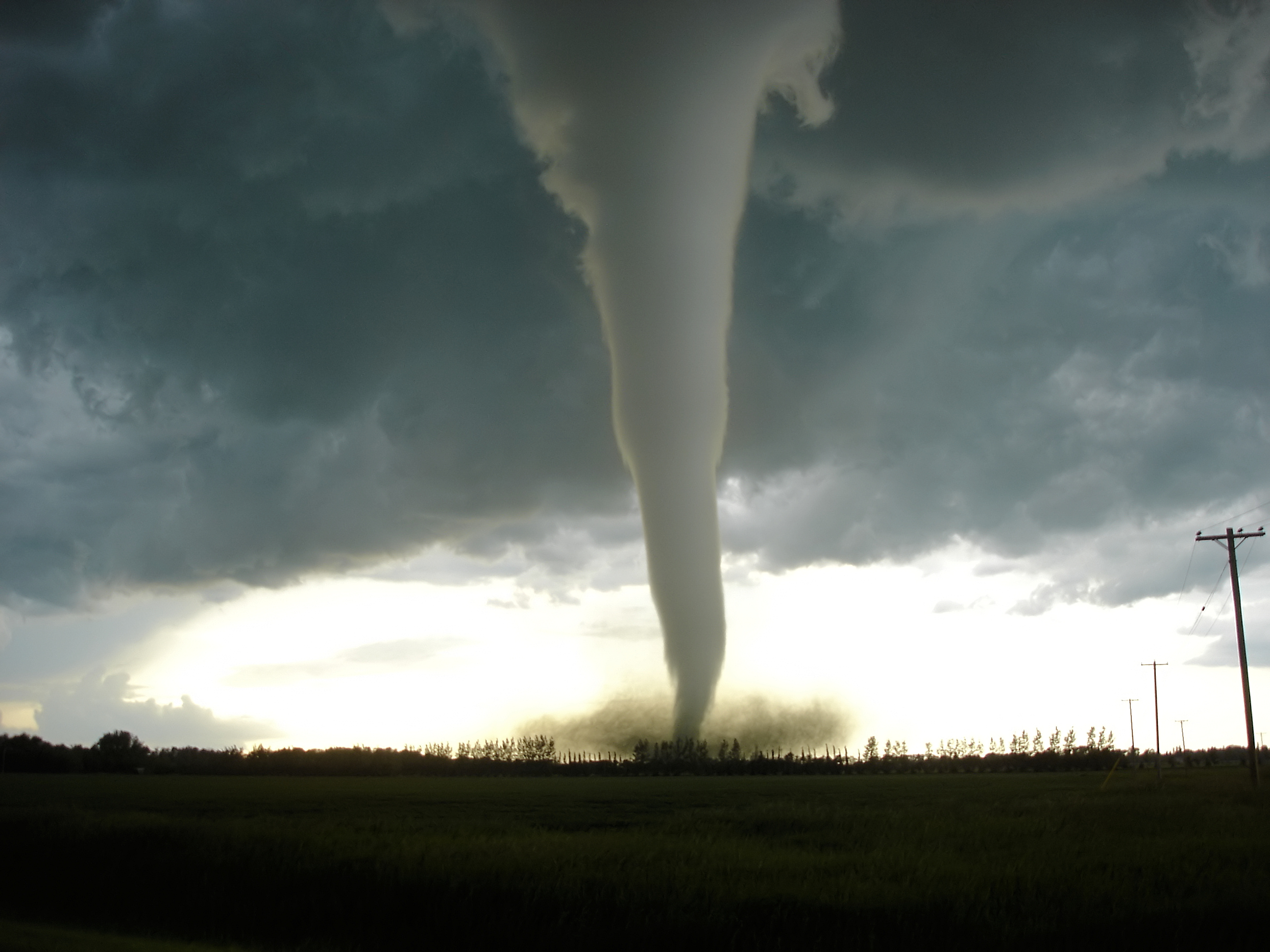
F5 in Manitoba by
Justin1569
Tornadoes are dangerous, violent and unpredictable storms. Even the weakest of them can harm people and cause property damage. Scientists measure them on the Fujita Scale. Those in the middle of the Fujita Scale–F3s–are as strong as or even stronger than Category 5 hurricanes in terms of wind speed. They have been portrayed in fiction as magical cyclones that can whisk you away to far off lands and as interesting funnels that harmlessly move things about. The reality is far more frightening, though no less interesting.

Tornadoes are Most Common in the United States

While not constricted to the United States, tornadoes most often occur in the spring and fall months in the U.S. An average of 800 to 1,000 reported tornadoes occur in the United States annually. They cause an average of 70 to 80 deaths in the country and more than 1,000 injuries–much more some years. Property damage from tornadoes can be in the billions in a single year.

Tornadoes Can Move and Spin Very Fast


Tornadoes are columns of air that appear during thunderstorms, however small. The columns spin or rotate at varying speeds from 400 miles per hour to more than 300 miles per hour. Tornadoes can travel at speeds up to 70 miles per hour, making them very difficult to outrun, even in a vehicle. They are also quite unpredictable, which lends to the danger they present.

The Paths of Tornadoes Can be Terrifyingly Wide and Long

The width of a tornado can be as much as a mile and wipe out whole neighborhoods as it goes along. Once it touches down, a tornado can cut a path 50 miles long before dissipating. Tornadoes like these are the exception rather than the rule, but it is best to stay out of the way of any tornado.

Not All Tornadoes Form Noticeable Funnels


It is a mistake to be on the lookout for noticeable funnels during thunderstorms, despite them being a tornado's most noteworthy characteristic. Tornadoes are, by nature, invisible. Only when a tornado sucks in moisture, dirt or debris does it become visible. Even then, rain or dark clouds may hinder a person's view of the tornado.

Tornadoes Can Last More than the Usual Few Minutes and They Can Happen at Any Time

Tornadoes are more common in spring and summer, as mentioned above. However, they can happen at any time of year. Furthermore, they are more common in the afternoon, but that does not mean they cannot happen at night or in the morning. Once they get started, they can last anywhere from a brief moment to an hour.

It is Impossible to Give Significant Warning for a Tornado

Unlike other weather events, it is not possible to give more than a few minutes of warning for a tornado. Tornadoes are much like tsunamis in that the situation must be read properly in order for people to predict the outcome. Weather experts can put out tornado watches hours in advance when they see a storm that may produce tornadoes. However, they cannot give a tornado advisory more than an average 13 minutes in advance at this time. That is why it is essential to listen carefully to the weather when there is a tornado watch.

When it comes to tornadoes, preparing for the unexpected is the only safeguard. Even homes that are built to withstand tornadoes can be leveled in a strong one. It is important to know where to take shelter in the event of a tornado and to pay attention when there are thunderstorms, especially if you are east of the Rockies in the United States.

Sources

Tornadoes, retrieved 6/5/11, environment.nationalgeographic.com/environment/natural-disasters/tornado-profile

Sunday, October 2, 2016

The 1925 Tri-State Tornado


Aftermath in Griffin, Indiana
The 1925 Tri-State Tornado was the single most deadly tornado in United States history. This massive cyclone ripped through parts of southeastern Missouri, southern Illinois and southwestern Indiana. Today, most experts believe that the Tri-State Tornado was a five on the Fujita Scale, with winds between 261 and 318 miles per hour. It traveled a total of 219 miles, giving it the longest recorded tornado track in the entire world.

The Tri-State Tornado started off in the Ozark Mountains near Ellington, Missouri at 1:01 p.m. on March 18, 1925. At the time, weather forecasters were not allowed to mention tornados in their warnings, and really forecasting a tornado was impossible. Even in recent years, tornados are unpredictable. However, today we are at least allowed to hear speculations of a forming tornado and decide if we want to take shelter. In 1925, this wasn’t an option. So, as the tornado was forming in the Ozarks and getting ready to race across three states at average speeds of between 56 and 73 miles per hour, people were complacently going about their day.

Fourteen minutes after the Tri-State Tornado formed, it was in Annapolis, Missouri. It destroyed 90% of the town and killed several citizens. It then moved across the farmlands of southeastern Missouri and across the Mississippi River. It did the most damage in Illinois. It hit town after town, destroying homes, businesses and vehicles, uprooting trees and killing citizens. The tornado killed 243 people in Murphysboro alone. It is estimated that the tornado averaged 3/4 of a mile wide, but was up to a mile wide at times.

After wreaking havoc in Illinois, the Tri-State Tornado moved into Indiana. It broke up twelve minutes after destroying a quarter of the town of Princeton, Indiana. In its wake were utterly devastated towns. Schools were destroyed with children still inside them. Houses filled with their occupants were moved across the land. Rescue workers dug through rubble to search for survivors for days in some places. There were fires, power outages and shattered families.

The Tri-State Tornado claimed an astounding 695 lives. More than two thousand people were injured by the storm and roughly fifteen thousand homes were destroyed. Since the time of the Tri-State Tornado, the ban on using the word tornado in weather forecasting has been lifted. Awareness of these dangerous storms has increased exponentially. Therefore, people are able to prepare for them. Nonetheless, it is very difficult and, at times, impossible to predict a tornado. Another tornado of this magnitude in the area could still be disastrous.