Monday, September 26, 2016

The Alnwick Poison Gardens

Alnwick Gardens
Photo by xlibber

The Alnwick Gardens are a group of public gardens attached to Alnwick Castle in Northumberland. The castle itself is the second largest in Great Britain. One of the gardens that helps make up the Alnwick Gardens is the Alnwick Poison Garden. This garden boasts some of the world's most dangerous plants, hence the name.

The history of the Alnwick Gardens goes back to 1750. The modern gardens were designed after a long period of neglect. The current Duchess of Northumberland decided to revamp the gardens when she became mistress of Alnwick Castle. The project began around 2000, but she did not begin the Poison Garden until five years later. The Duchess wanted a garden that was filled with narcotic, poisonous and deadly plants. The initial design included some medicinal plants, but she had them removed to maintain the concept of the Poison Garden.

The Duchess of Northumberland had father and son garden designers Jacques and Peter Wirtz design the modern Alnwick Gardens. Besides the Poison Garden, there is the Rose Garden, the Tree House, the Serpent Garden, the Ornamental Garden, the Bamboo Labyrinth and more. The Poison Garden has arguably the most socially significant purpose of all the Alnwick Gardens. Guests who visit the Alnwick Poison Garden are led by guides who teach them about the plants and about drug abuse prevention. The drug abuse prevention message stems from the plants that reside in the Poison Garden.

The plants that grow in the Alnwick Poison Garden could be used to make an array of illegal narcotics. There are poppies, which are used to make opium. There is Atropa belladonna, also known as deadly nightshade, which is famous for its use as a poison. Belladonna is also a hallucinogenic. Cocoa also grows in the Poison Garden. Cocoa sounds like a lovely plant, but it is actually used to make cocaine. Strychnos nux-vomica is another deadly plant, which is used to make strychnine. Also included are hemlock, cannabis and more.

The Poison Garden at Alnwick Gardens is on around the clock surveillance for the safety of the public and would-be thieves. Some of the plants are even kept in specially fenced areas to avoid accidental poisoning or theft of the plants for use in making narcotics. The message at the Poison Garden is anti-drug, so it is of the utmost importance that the plants there be used to educate the public, not harm people.

Source

Alnwick Garden, retrieved 12/2/10

Monday, September 12, 2016

See a Night Sky Underground at New Zealand's Glowworm Caves


Intricate sign at the caves
Photo by A.Aruninta

The Glowworm Caves, or the Waitomo Caves, are amazing natural wonders located in Waitomo on North Island in New Zealand. There is a series of them with millions of glowing larvae, pupae and bugs populating their ceilings. Visitors liken the effect of these glowing creatures to that of a particularly starry night sky. In some spots, you can see glowing dots on strands that hang from above, almost like icicle Christmas lights.

The little bugs, larvae and pupae that are responsible for the decor of the Glowworm Caves are known Arachnocampa luminosa, New Zealand fungus gnats or, less commonly, glowing spider bugs. These bugs go through four basic life stages. They begin as eggs, which hatch to become larvae (during which time they molt four times), which in turn pupate. Then comes the adult. New Zealand fungus gnats begin glowing when they reach the larval stage of their development.

Arachnocampa luminosa larvae spend their days hiding in cracks and crevices in the Glowworm Caves. At night, they come out and hide in little silk tunnels they have constructed. These silk tunnels are for catching prey. They are also used as a dwelling of sorts during the pupal stage of their development. New Zealand fungus gnats spend about three weeks as eggs, six to twelve months as larvae and about twelve days as pupae. Adults come out of the pupal stage unable to eat. They have no mouths. They will only survive long enough to procreate. For the male Arachnocampa luminosa, this will be between three and five days. The female will only survive one or two days. After laying her eggs, she will sometimes stop glowing, always dying shortly thereafter.

There is no shortage of New Zealand fungus gnats in New Zealand. However, the Glowworm Caves are the most popular places to view these bioluminescent bugs. The darkness of the caves makes them a perfect place to witness the glow of the Arachnocampa luminosa.

There are literally hundreds of guided tours available for visitors to the Glowworm Caves. The caves may be entered on foot or via the Waitomo River in a raft or canoe.

Sources

New Zealand Fungus Gnat (NZ Glowworm), retrieved 9/12/16

Sunday, August 28, 2016

The Great Pacific Garbage Patch


The amount of waste in the world’s oceans has been surging in the past century, and the problem continues to get worse. It is at the point where there are areas of the ocean where trash outnumbers sea life (including plankton). These areas of the ocean are known as trash swills. There are a number of them on Earth, and each of Earth’s oceans contains at least one. The greatest of all of these trash swills is commonly known as the ‘Great Pacific Garbage Patch.’ It is also known as the ‘Plastic Continent.’

The ‘Great Pacific Garbage Patch’ is located in the Pacific Ocean between Hawaii and California. It is roughly 1,000 miles off of the coast of California. Trash from Japan, the United States, Mexico and various other countries are caught in the ocean’s currents and eventually wind up in the North Pacific Subtropical Convergence Zone. Some of this trash breaks into pieces, eventually comes free and floats away, sinks to the ocean floor or floats on or below the surface.

It is difficult to determine the size of this mass of plastic and trash for various reasons. Firstly, the ‘Great Pacific Garbage Patch’ does not stay still. The collection of plastic and trash is also amorphous, so getting a precise measurement would take some doing. There is also the fact that not all of the trash is on the surface. To get a correct measurement of its size, one would have to measure its depth as well, which is no simple task. Estimates regarding the size of the ‘Great Pacific Garbage Patch’ have ranged from the size of Texas to one and a half times the size of the United States.

Eighty percent of the ‘Great Pacific Garbage Patch’ is recyclable plastic material. It’s no wonder some people have taken to calling it the ‘Plastic Continent.’ There is also no feasible way of removing it and recycling it. The ‘Great Pacific Garbage Patch’ is getting larger with no end in sight. And this is only the tip of the iceberg of the world’s plastic problem. Just imagine how much of it is sitting around on this planet, not being recycled and endangering wildlife. When you take into account the fact that plastic has only been mass-produced for the past sixty years or so, it is easy to imagine that our oceans may be literally clogged with plastic in the foreseeable future.

The amount of plastic compared to the amount of sea life in the ‘Great Pacific Garbage Patch’ is 6:1. Researchers have been discovering all kinds of sea life, including marine birds, with pieces of plastic from the swill in their stomachs. Some accounts have made it seem as if researchers would be hard pressed to find an animal in that area without some plastic in its stomach. The plastic breaks down into smaller pieces and begins to look like food to the animals. They can also become entangled in or otherwise inhibited by the debris. This can be a major problem if it stops the animal from being able to move or eat.

At this time, attempts are being made to study the ‘Great Pacific Garbage Patch.’ However, nothing is being done about it and there may be nothing that can be done about it. No country is going to claim responsibility for the waste and end up footing a bill that could probably reach the billions. There is also the question of how all of that floating trash could possibly be collected and where would we put it? It has been estimated that the ‘Great Pacific Garbage Patch’ contains roughly 3.5 million tons of trash.

Update: Research into the impact of the Great Pacific Garbage Patch and how to clean it up is currently ongoing. There is no doubt that the task will be monumental.

Sources

Randille, Michelle, Great Pacific Garbage Patch, retrieved 12/16/09, discovery.com/news/2009/08/28/pacific-garbage.html

Think Beyond Plastic, Garbage Patch, retrieved 12/16/09, greatgarbagepatch.org/index.html

De-mystifying the “Great Pacific Garbage Patch” or “Trash Vortex,” retrieved 12/16/09, marinedebris.noaa.gov/info/patch.html#3

Saturday, July 16, 2016

Yellowstone's Morning Glory Pool

The pool has barely retained its blue color.
Photo by Miguel Hermoso Cuesta

Yellowstone National Park is home to some of the most amazing natural sights in the world, not least of which is the Morning Glory Pool. The Morning Glory Pool is a hot spring that attracts quite a few visitors. It is known for its vibrant color.  However, much of that has diminished over the past decades. Nonetheless, the pool is still stunning to behold. The change in the pool’s color is also very interesting in that it gives us a first hand look at the effect that pollution can have on the world that surrounds us.

The Morning Glory Pool is located on the northern edge of the Upper Geyser Basin. It was named in 1883 for its magnificently deep blue color that nearly matched the flower for which it was named.

This pool is roughly 23 feet by 26 feet and is about 23 feet deep. Currently, the temperature of the water in the Morning Glory Pool is around 171.6 degrees Fahrenheit. The water is clear enough that you can see the way that the sides taper down into its depths. Viewed from some angles, this gives the illusion that the pool is in fact running down into the center. This also makes the pool seem as if it has a “stem,” which makes its name that much more appropriate.

Unfortunately, the pool has changed color over the years because of the acts of uncaring or unwitting visitors. Tons (yes, tons) of trash have been thrown into the pool, effectively blocking the vents that keep the pool so hot. Thermophilic bacteria that need high temperatures to survive cause the blue color of the pool.

When the vents became blocked by trash, the temperature in the pool started to drop, thus killing some of these bacteria. The drop in temperature also made it possible for other bacteria to thrive in the Morning Glory Pool. These new bacteria are red, yellow and orange and are changing the pool’s color from the outside in. As the pool gets cooler, the new bacteria move closer to its center. Given enough time, the entire pool could change if the vents do not get opened back up.

An old road used to go directly by the Morning Glory Pool, so there were many more visitors to it in the past. Today that road is gone. Visitors must walk or bicycle for 1.5 miles both ways to get to the pool; a three-mile trip total. This means fewer visitors and fewer opportunities to steal pieces of the edge of the pool or throw trash into its depths.

Because the Morning Glory Pool is a geyser it is hoped that it will one day blow the trash loose and thus remove the blockage from its thermal vents. However, whether it will do so or not is uncertain, especially with the amount of trash that is in it. For now, we can only hope that some effort on our part or some natural occurrence will return the pool to its original, magnificent state.

Monday, June 27, 2016

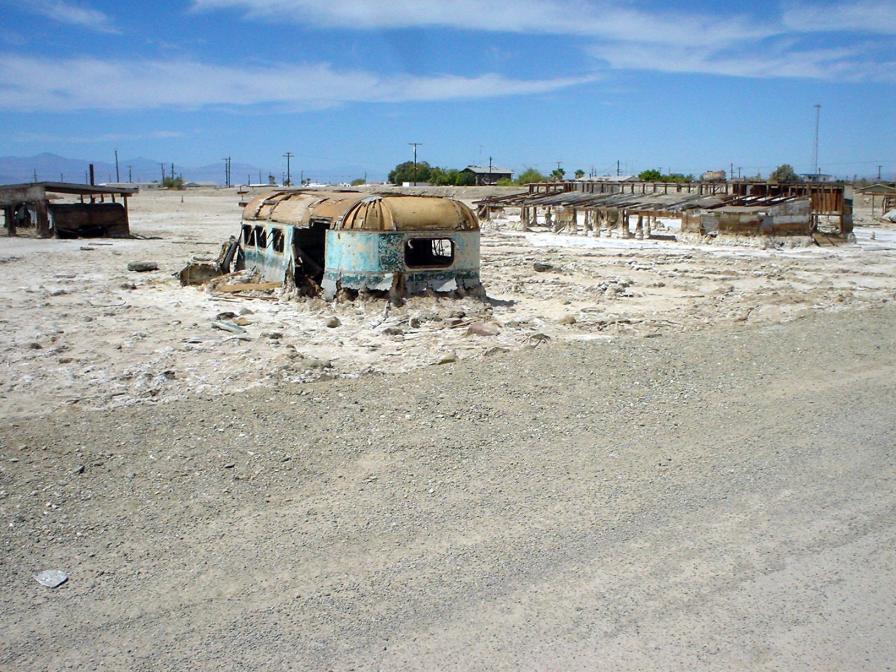
Salton Sea: A Former Paradise Abandoned

Abandoned buildings at Salton Sea
The Salton Sea is a semi-man-made lake in California, which sits directly on the San Andreas fault. It is home to numerous bird and fish species, some of which are endangered. Because it is an important stop along the Pacific Flyway, it is critical that it is safe for the birds that flock there.

Unfortunately, there have been several major die-offs for both the birds and the fish of the Salton Sea. And there is much controversy surrounding the cause of these die-offs.

The Salton Sea lies in a natural basin called the Salton Basin or the Salton Trough. This basin is very close to the Colorado River and it is easy for water in the area to drain into the basin because it is so far below sea level. The Salton Basin has been filled with water off and on as far back as 700 A.D. It was most recently filled in 1905.

In 1905 an irrigation canal headworks on the Colorado River broke and the river began pouring into the Salton Basin. Unfortunately, the town of Salton and some Native American land were submerged by the in-flowing water. Luckily, the area was not highly developed and all escaped what could have been a major disaster. Engineers were unable to fix the break immediately and so the Colorado River continued to pour into the Salton Basin for more than a year. Thus, the Salton Sea, as we know it today, was born. It is currently around 45 miles long and 20 miles wide.

The area of the Salton Sea has natural salt deposits and the Colorado River is relatively salty itself. Therefore, when the river poured into the basin and dissolved some of the natural salt, the Salton Basin became a salt lake. In fact, it is currently 25% saltier than ocean water because some of the water that flows in today is also salty. Because it is roughly 227 feet below sea level, no water flows out of the Salton Sea, only in. The lake is able to maintain its water level because of evaporation, but the salt doesn’t evaporate. So, what we are left with is a lake that constantly collects more and more salt, but does not dispose of it.

The Salton Sea is fed by the New River, the White River, the Alamo River and numerous agricultural drain offs and creeks. Therefore, not only water comes into the Salton Sea; fish do as well. There are many species of fish in the Salton Sea and it has become a very popular fishing spot for both humans and birds. In little more than one hundred years, the Salton Sea has developed an ecosystem that is critical to the survival of several endangered species. The problem is that it may not be a safe place for these animals.

A number of large-scale die-offs of fish and birds have occurred on the Salton Sea over the years. Some people believe that contaminants are coming into the Salton Sea from the drain offs and rivers and that they are causing the die-offs. Others believe that it is the excess of naturally occurring salt, nutrients and Selenium. One thing is agreed upon by both groups–something is killing these animals and something has to be done about it. Various organizations are looking into the problem and researching possible solutions.

The Salton Sea is a wonderful part of the California landscape and it is rather unique. It would be a horrible thing to lose all of the animals that grace the lake and only be left with what would essentially be a giant bowl of salt water and animal bones. Fortunately, we live in a time where it may be possible to stop the Salton Sea from “dying,” though we haven’t been able to stop things such as this before. However, with some elbow grease and awareness, a biological travesty can be avoided. Thankfully, we have that choice.


Wednesday, June 15, 2016

Hurricane Safety Tips

ISS Photo of Cyclone Katarina
An average of five or six hurricanes occur every year in the Atlantic and just one of these storms can leave a path of destruction through several states. States on the Atlantic coast are the most susceptible to hurricane damage. Therefore, if you live on the Atlantic coast, even in the northern states, it is important to be prepared for hurricanes.

Keep a First-Aid Kit 


Whether you plan to stay at home or to evacuate, you should keep a first-aid kit with you. (Pack it in the trunk of your car ahead of time, if you know you plan to leave in the event of a hurricane.) Even the smallest wounds should be cared for in an emergency to prevent infection. The last thing you want is a small scrape turning into a medical emergency when medical aid may not be easy to obtain.

The bare essentials for a first aid kit:
  • Bandages of all sizes
  • Medical tape
  • Scissors
  • Tweezers
  • Antibacterial ointment
  • Antiseptic
  • Gauze
  • Hand sanitizer
  • Ace bandage
  • Over the counter pain reliever/fever reducer 


Keep a Hurricane Kit


A hurricane safety kit should include items that will keep you warm, protected from the sun, fed, watered and clothed for a minimum of three days. If you are evacuating in the event of a hurricane, you may want to keep this kit packed up and ready to be placed in your car at a moment's notice. If you plan to stay home, keep the kit in waterproof containers in your home. You never know if you will be forced out of your home by damage during a hurricane. You want to have those essentials ready and dry.

A hurricane kit should include, at minimum:

  • A change of socks and underwear for each person
  • Sunblock
  • Flashlights, small battery-operated radio and extra batteries (packed in watertight plastic)
  • A necklace whistle (for drawing the attention of rescue workers)
  • At least one blanket per person (Pillows are a luxury. Only pack them if you have the room or you can carry them.)
  • One towel per person packed in watertight plastic
  • Waterproof strike anywhere matches
  • Baby wipes (helps keep you sanitary when shower facilities are scarce)
  • Enough water for at least three days (one gallon per day, per person)
Food:

Meal replacement bars, trail mix, peanut butter and crackers, canned meat, beef jerky, canned vegetables, canned fruit and anything else that keeps for long without refrigeration. Be sure to bring plastic eating utensils, plates and cups.

Be Ready When a Hurricane Warning is Issued


You want to have your kits ready long before a warning is issued. This way, you miss the rush to the grocery stores. In addition, you want to make sure your gas tank is full in case you have to leave. If you have a shelter, hotel or other safe place out of the area in mind, leave as soon as possible so you beat the evacuation traffic. You cannot do this if you are not prepared before the warning. Make sure to gather all of the family's essential medications when a hurricane is expected as well. You can bring them with you to the shelter.

If You're Staying Home, Make Sure Your Home is Safe


It is possible to be injured inside your home during a hurricane, even if your home is sturdy. There are a few things you can do to make sure you are as safe as possible inside your house during a hurricane, if you decide to stay. Of course, in the event of a strong hurricane, your best choice is to evacuate.

Board up your windows and doors. This is to prevent breaking windows and doors from flying through your house and hurting you. Make sure all of the things you need and you are in areas of the house that are as far from trees as possible. Shut off the gas lines in your house in case something breaks.

It is important to remember that no matter how much you prepare, a strong enough hurricane can render your preparation useless. Therefore, your safest option is to evacuate while evacuation is still possible. Even if you do evacuate, do not forget your kit.

Wednesday, May 18, 2016

Rabbits Are Destroying Natural Habitats in Australia

Wild rabbit
Courtesy of John Loo
Australia has been home to one of the world's most destructive invasive species for more than a century–rabbits. Rabbits can annihilate plant species while causing soil erosion that drives native species out of their habitats. They eat a lot and reproduce prolifically, making them a major problem for Australia.

In 1859, 24 European rabbits were released into the wild in Australia for sport hunting. In only 67 years, their numbers increased to an estimated 10 billion. Rabbits propagate their species quite aggressively. Female rabbits can birth up to five litters, each containing 4-7 offspring annually. This means that it would take a single breeding pair of rabbits 1.5 years to increase the population by 182 rabbits. The consequences of this hyper-breeding is seen everywhere there are rabbits.

Rabbits are burrowing mammals. When their population gets out of control, this burrowing behavior damages the soil and causes soil erosion. They also have a habit of stealing burrows from other burrowing mammals, when they don't have enough to support their population. They are not only stealing the homes of these creatures, but they are making the land incapable of supporting these creatures in the future.

Another aspect of local eco-systems that rabbits destroy is the food supply, which is actually another cause of soil erosion. Studies show that it takes only two rabbits on one hectare of land to keep the plants on that land from growing. They are solely responsible for the near destruction of Hibiscus insutaris, a local plant. Rabbits are also guilty of a habit called ringbark. They use their teeth to remove the bark of trees in a ring around them. This effectively kills the tree. They also eat the little saplings, which keeps the trees from coming back. Other animals find it difficult to compete with the rabbits for food. Roughly 1/8 of all of the mammal species in Australia have been eradicated as a result of rabbit infestation.

All of this destruction is costing the Australian government hundreds of millions of dollars a year. Because of this and the destruction of native species, several attempts have been made to wipe out the rabbit population in Australia. (Animal lovers will not like their methods, but there is no denying that something needs to be done before more animals are made extinct because of this invasive species.) In 1950, the rabbits were given the myxomatosis virus in an attempt to reduce the population. It worked. Nearly 100% of all rabbits in Australia were killed. However, some of the rabbits became immune to the virus and the population became problematic again within a few decades. In the mid to late 90s the method was tried again with a new virus. This virus kills millions of the rabbits annually, but this is still not enough.

There are currently hundreds of millions of rabbits in Australia. This may not be as bad as the billions that once were, but if efforts to reduce the population cease for even a few years, billions of rabbits would appear again. It is a constant job to keep these rabbits in check and there is no end is sight.

Sources

Invasive Animals CRC, Rabbits, retrieved 3/15/10, invasiveanimals.com/invasive-animals/rabbits/index.html

The Effects of Rabbits on the Australian Environment, library.thinkquest.org/03oct/00128/en/rabbits/effect.htm

Animal Planet, Weird True and Freaky, Outback Rabbit Invasion