Showing posts with label Volcanoes. Show all posts

Tuesday, November 22, 2016

The 7 Tallest Volcanoes On Earth

Mount Saint Helens 1985
At this time, there are more than 1,500 volcanoes on the surface of the Earth. This number does not include the volcanoes that exist under the ocean, of which there are potentially thousands. The largest of these 1,500 volcanoes pose a major threat to those who live in their shadows. Some of them even have the ability to threaten lives thousands of miles away. Here is a list of some of the largest volcanoes on Earth by height. Some of them are not a major threat, despite their size. Others have killed thousands in the past and could readily do so again in the future.

Mount Vesuvius


Height: Roughly 4,000 feet

Type: Stratovolcano

Status: Active

Year of Last Eruption: 1944

Mount Vesuvius is located on the west coast of Italy, on the Tyrrhenian Sea. This is the very same volcano that was responsible for the destruction of the cities of Pompeii and Herculaneum in 79 A.D. Mount Vesuvius is the shortest of the volcanoes on this list. However, the height of this volcano has little bearing on how deadly it can be. Today there are millions of people living within range of this volcano. A particularly large eruption could have terrible consequences.

Mount Pelee


Height: Roughly 4,582 feet

Type: Compound Volcano

Status: Dormant

Year of Last Eruption: 1929-1932

Mount Pelee is located on the island of Martinique in the West Indies. This volcano became famous after an eruption in 1902 that destroyed the town of St. Pierre. An estimated 29,000 people were killed.

Mount Pinatubo


Height: Roughly 4,872 feet

Type: Stratovolcano

Status: Active

Year of Last Eruption: A secondary eruption occurred in 1994.

Mount Pinatubo is located in the Philippines. The largest eruption that has happened there in recent history occurred in 1991. This eruption was unique in that scientists had been able to predict it and many people had been evacuated. Nonetheless, 847 people died and 23 went missing as a result of the massive eruption.

Mount St. Helens


Height: 8 Roughly 8,364 feet

Type: Stratovolcano

Status: Active

Year of Last Eruption: 2004-2008

Mount St. Helens is located in the Cascade Mountains in Washington State. It is the most famous volcano in the U.S.A. because of its eruption in 1980. The eruption caused the north face of this once picturesque mountain to collapse. It destroyed nearly 1,314 miles of forest and killed hundreds of large animals. Fifty-seven people were killed in all, despite warnings of an imminent eruption.

Mount Tambora


Height: Roughly 9,354 feet

Type: Stratovolcano

Status: Active

Year of Last Eruption: 1967

Mount Tambora is located on the island of Sumbawa in Indonesia. Mount Tambora had the largest eruption in recorded history in 1816. That year became known as the year without summer all over the world. The eruption killed an estimated 80,000 people. The people of New England, nearly 10,000 miles away, were hit pretty hard by weather changes caused by the eruption. They recorded frost every month of that year and it even snowed in June.

Mount Etna


Height: Roughly 10,925 feet

Type: Stratovolcano

Status: Active

Year of Last Eruption: 2008

Mount Etna is located on the island of Sicily, Italy. It is the most active and tallest of all the volcanoes in Europe. Mount Etna has erupted more than 200 times since 1500 BC. This includes a series of eruptions that lasted thirteen years between 1972 and 1992. Eruptions from the volcano have threatened to destroy the town of Catania several times. Attempts have been made twice to divert the flow of lava away from the town. Both efforts failed.

Mauna Loa


Height: Roughly 13,000 feet above sea level, Roughly 56,000 feet from base to summit

Type: Shield Volcano

Status: Active

Year of Last Eruption: 1984

Mauna Loa is located on the island of Hawaii. Its name means Long Mountain in the language of the natives. It is not only the tallest volcano on Earth, but it is also the tallest mountain from base to summit. The volcano takes up roughly half of the island. Mauna Loa has erupted 33 times since 1843.

These volcanoes are some of the largest in terms of elevation. There are other, larger volcanoes on Earth that are considered larger due to volume and potential for disaster. For example, the megavolcano that resides under Yellowstone Park has the potential to affect weather the world over and to kill millions. The volcanoes listed here are big and dangerous, but they are not the only volcanoes on the planet that are a threat to mankind.

Sources


Ball, Jessica, Mount Etna-Italy, retrieved 7/15/09, geology.com/volcanoes/etna/

Mauna Loa; Earth’s Largest Volcano, retrieved 7/15/09, hvo.wr.usgs.gov/maunaloa

Ball, Jessica, Mount Vesuvius-Italy, retrieved 7/15/09, geology.com/volcanoes/vesuvius

Tambora, retrieved 7/15/09, earlham.edu/~ethribe/web/tambora.htm

Pinatubo Volcano “The Sleeping Giant Awakens”, retrieved 7/15/09, park.org/philippines/pinatubo

Discover Mount-Pelee, one of the deadliest volcano ever, retrieved 7/15/09, mount-pelee.com/index.php/component/option,com_frontpage/itemid,1l/lang;en/

Sunday, March 13, 2016

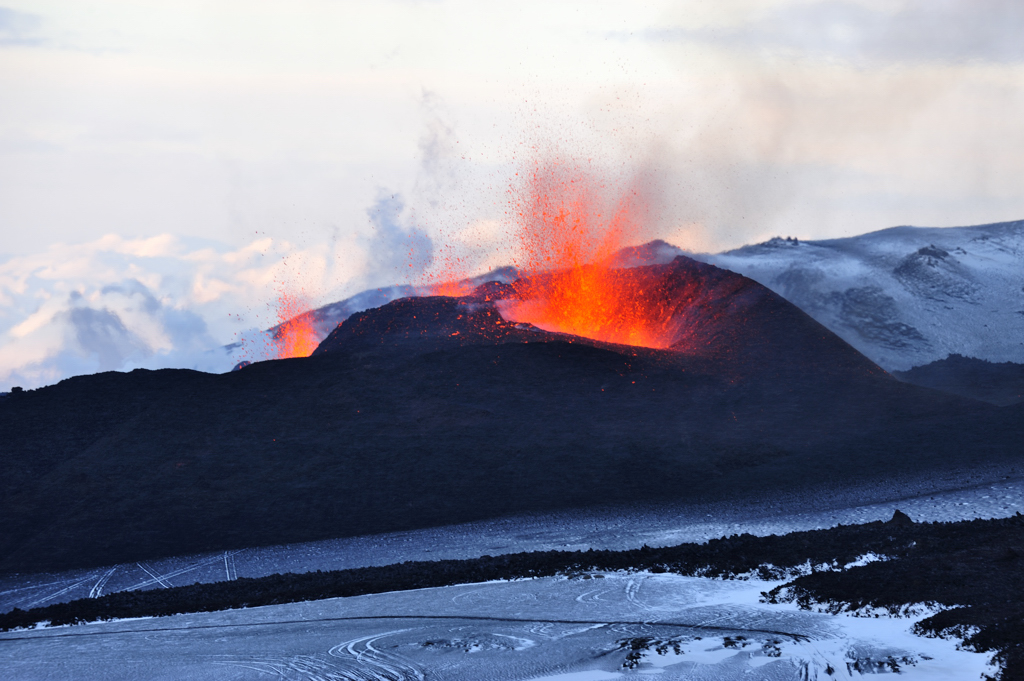
Interesting Facts About Iceland's Volcanoes

Fire spewing out of Eyjafjallajokull
during the 2010 eruptions
Courtesy of Ulrich Latzenhofer
Iceland and its volcanoes have been in the news a lot in the past few years. The Eyjafjallajokull volcano in Iceland was been very active in March and April of 2010. The ash spewing forth from this volcano resulted in the grounding of flights as far away as England, due to the danger it presents to airplanes. Prior to this tantrum, the Eyjafjallajokull volcano had not erupted for nearly 200 years. All of this attention serves to remind us that Iceland is a land of many volcanoes, some of which can have global consequences should they erupt. With that in mind, here are a few facts about Iceland's volcanoes that can give us an idea of what goes on there in the "land of fire and ice."

Hawaii gets a lot of attention for its volcanoes. This is because it was formed by volcanoes. Evidence of their activity is present everywhere there. Nonetheless, there are only two active volcanoes in the State of Hawaii. Iceland has between 20 and 30 active volcanoes. That is more active volcanoes than any other place on Earth.

The most active volcano in Iceland is Hekla. Hekla has an elevation of 4,892 feet. It is a stratovolcano that is located in southern Iceland. Hekla has erupted roughly once every ten years for the past fifty years. A Hekla eruption can come on with little to no warning and can last for weeks or months. Hekla was less active in the past fifty years. However, for some time, there was hardly a century that passed without at least one eruption from Hekla.

Iceland was formed from volcanic activity, like Hawaii. The American and Eurasian tectonic plate boundary goes through Iceland. The two plates pull apart, making it easy for lava to push through the gap. This is how Iceland was formed and why it has so many active volcanoes today.

In the past 500 years, nearly one-third of the Earth's lava output has spewed forth in Iceland. Furthermore, 83% of the world's sub glacial eruptions have occurred in Iceland. To put that into perspective, the area of Iceland is 39,707 square miles of land. The entire Earth has roughly 57,393,000 square miles of land area. Iceland is sure pumping out a lot of lava for such a small portion of the Earth.

From the above, you can clearly see why Iceland is called the "land of ice and fire." Of course, given its position on this Earth, there is a lot of ice in Iceland. However, residents can warm up by taking a dip in the large number of the geothermal spas there. Despite the scary number of active volcanoes, Iceland is easily one of the most beautiful and interesting places on Earth.

Sources

Volcanology Highlights, retrieved 4/16/10, volcano.si.edu/world/region.cfm?rnum=17&rpage=highlights

Volcanoes in Iceland, retrieved 4/16/10, kwintessential.co.uk/articles/article/Iceland?Volcanoes-in-Iceland/538

Seach, John, Hekla Volcano, retrieved 4/16/10, volcanolive.com.hekla.html


Friday, February 5, 2016

Mud Volcanoes

Chabahar Mud Volcano
Photo by Amirhossein Nikroo
Mud volcanoes are a less terrifying, but still dangerous cousin of magma volcanoes. They are also known as sedimentary volcanoes and gas-oil volcanoes. These volcanoes occur where there are deep deposits of gas and oil beneath the surface. There seems to be a connection with fault lines as well. Like magma volcanoes, mud volcanoes have dormant and active phases. During their active phases, they do not spew liquid hot rock and ash while causing massive earthquakes and lightning storms, but they are capable of spewing fire and enough mud at such a rate to displace or even kill human beings.

If you want to see a mud volcano, Azerbaijan in Eurasia is the place to go. There are no active magma volcanoes in the area, but there are hundreds of mud volcanoes. In fact, Azerbaijan has most of the mud volcanoes on the planet–more than half. However, most of the mud volcanoes there only emit small amounts of cool mud and gases. They can be between 16 feet and 1,640 feet tall. People do not live close enough to them to be affected by active mud volcanoes in Azerbaijan, but that is not the case in other parts of the world.

In 2006, a mud volcano became a problem in a residential area of Sidoarjo, Indonesia. The volcano appeared, erupted and the resulting mudflow killed thirteen people. Thousands have been forced from their homes by what has become known as the Lusi Mud Flow. The mudflow continues to this day. Interestingly, this extraordinarily large and dangerous mud volcano may not be a natural occurrence. Researchers have reason to believe that a local gas exploration well caused the volcano. Somehow, the pressure created led to a vent opening up and pouring excessive amounts of mud into the area.

There is still a lot to learn about mud volcanoes. They have not been studies as extensively as their noisy and deadly cousins have. We do know that built up pressure beneath the surface is involved in the birth of mud vents. We also know that they do not cause as much damage as magma volcanoes, though they can produce earthquakes and balls of fire. Because it appears they can be triggered by careless drilling, there will doubtless be much more research into what exactly causes them and how we humans can avoid being one of these causes.

Sources


Mud Volcanoes in Azerbaijan, retrieved 12/29/10, azerb.com/azmud_volcanoes.htm